
Cybersecurity has always been a game of cat and mouse—but artificial intelligence is changing the rules.
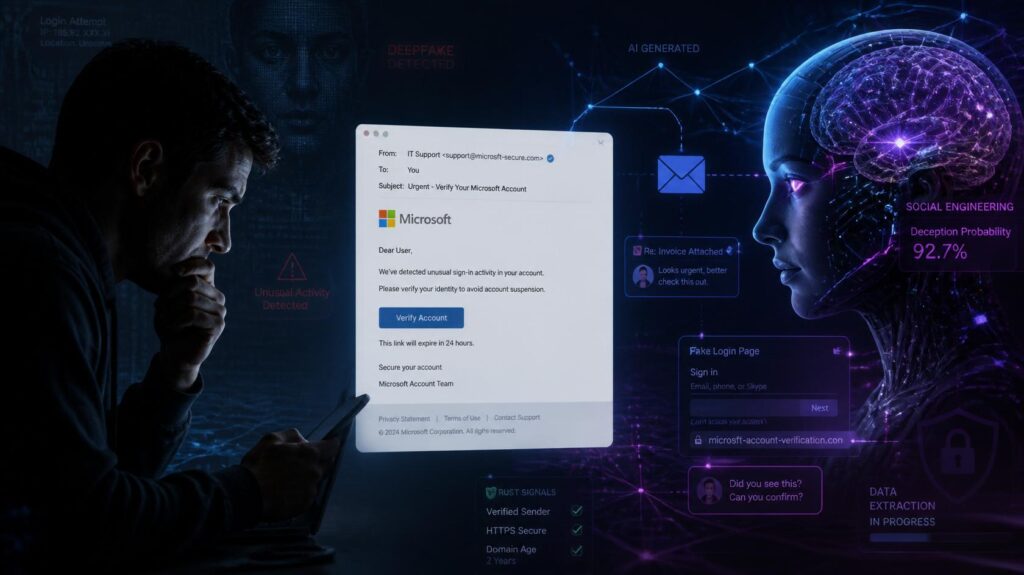
Social engineering attacks, once easy to spot thanks to broken grammar, awkward phrasing, and suspicious requests, have evolved dramatically. Today, AI is helping attackers craft messages, impersonate people, and manipulate trust at a level that’s never been seen before.
The real danger? These attacks don’t target systems—they target people.
Let’s break down how AI is making social engineering more dangerous—and more importantly, what you can do to defend against it.
The Evolution of Social Engineering
Traditionally, social engineering attacks relied on simple tactics:
- Generic phishing emails
- Obvious misspellings
- Poorly disguised impersonations
These worked—but only to a point.
Now, AI has removed many of those limitations.
Attackers can:
- Generate perfectly written emails in seconds
- Mimic tone, language, and even personality
- Scale attacks across thousands of targets with precision
The result? Fake messages that look, feel, and sound real.
How AI Makes Social Engineering Smarter
1. Hyper-Personalized Phishing Attacks
AI can analyze publicly available data—like LinkedIn profiles, company websites, and social media—to craft tailored messages.
Instead of:
“Dear user, your account has been compromised…”
You might see:
“Hi Norman, I saw you’ve been handling recent support requests—can you review this urgent ticket before the president escalates it?”
It feels legitimate because it is based on real context.
2. AI-Generated Conversations
Attackers are no longer limited to one email.
Using AI chat capabilities, they can:
- Engage in back-and-forth conversations
- Answer questions convincingly
- Adapt responses in real time
This removes one of the biggest red flags—inconsistent or vague replies.
3. Deepfake Voice and Video Impersonation
One of the most alarming developments is AI-generated voice cloning.
Attackers can:
- Mimic executives or coworkers
- Call employees with urgent requests
- Add pressure using authority and urgency
Imagine receiving a call that sounds exactly like your manager asking for sensitive information or a wire transfer.
4. Automated Attack Scaling
AI allows attackers to:
- Send thousands of customized messages instantly
- Test variations and learn what works best
- Optimize attacks like a marketing campaign
This means more attacks, better quality, and higher success rates.
5. Bypassing Traditional Filters
Older phishing attacks were easier to detect because of:
- Poor grammar
- Suspicious wording
- Repetitive templates
AI eliminates these weaknesses, making detection tools—and people—work harder.
Why This Matters More Than Ever
The biggest shift isn’t just technical—it’s psychological.
AI-powered social engineering:
- Feels more human
- Builds trust faster
- Creates urgency more effectively
And because it targets people—not systems—even strong security tools can’t fully stop it.
How to Counter AI-Driven Social Engineering
The good news? Even though AI makes attacks smarter, strong habits and awareness still provide powerful protection.
1. Slow Down and Verify
Most attacks rely on urgency.
Before acting:
- Pause
- Verify the request through a second channel
- Confirm with the actual person (not the message sender)
2. Be Skeptical of “Perfect” Messages
Ironically, better-written messages can be more dangerous.
Watch for:
- Requests involving money, credentials, or sensitive data
- Sudden urgency or pressure
- Slight inconsistencies (email domain, tone shift, unusual request)
3. Use Multi-Factor Authentication (MFA)
Even if credentials are stolen, MFA adds a critical layer of protection.
4. Train Employees Continuously
Security awareness training should now include:
- AI-generated phishing examples
- Voice impersonation scenarios
- Real-world simulations
People need to recognize modern threats—not outdated ones.
5. Establish Clear Verification Processes
Organizations should implement policies like:
- Verifying financial requests via phone
- Confirming changes to account details
- Never sharing credentials—even internally
Clear processes remove ambiguity—and ambiguity is what attackers exploit.
6. Limit Public Exposure
Attackers use publicly available data to personalize attacks.
Reduce risk by:
- Limiting sensitive details shared online
- Being cautious about what is posted publicly
- Reviewing company exposure regularly
7. Use Advanced Email and Security Tools
Modern security solutions can detect:
- Behavioral anomalies
- Suspicious patterns
- AI-generated phishing indicators
But technology should support—not replace—human awareness.
Final Thoughts
AI is reshaping cybersecurity—and social engineering is at the center of that transformation.
Attacks are smarter.
Messages are cleaner.
The deception is more convincing.
But the core defense hasn’t changed:
Awareness, skepticism, and verification are still your strongest tools.
Because at the end of the day, attackers aren’t just hacking systems—they’re hacking trust.
And that’s something only people can defend.